Fertilizer Giants, Quiet Lobbies, and the Soil Science They Don't Want You to Read
Every spring, American farmers make a familiar calculation: how much nitrogen to apply, which brand to purchase, and how to absorb the cost. It is a ritual so deeply embedded in modern agriculture that it feels like natural law. But the scientific literature increasingly suggests it does not have to be this way — at least not for farmers who incorporate hemp into their rotations. The question worth asking is why that literature remains largely invisible to the policymakers who could act on it.
What the Research Actually Shows
Hemp is not a nitrogen-fixing legume in the classical sense. It does not host rhizobial bacteria the way soybeans or clover do. What it does, however, is considerably more nuanced than the fertilizer industry's silence on the subject might imply.
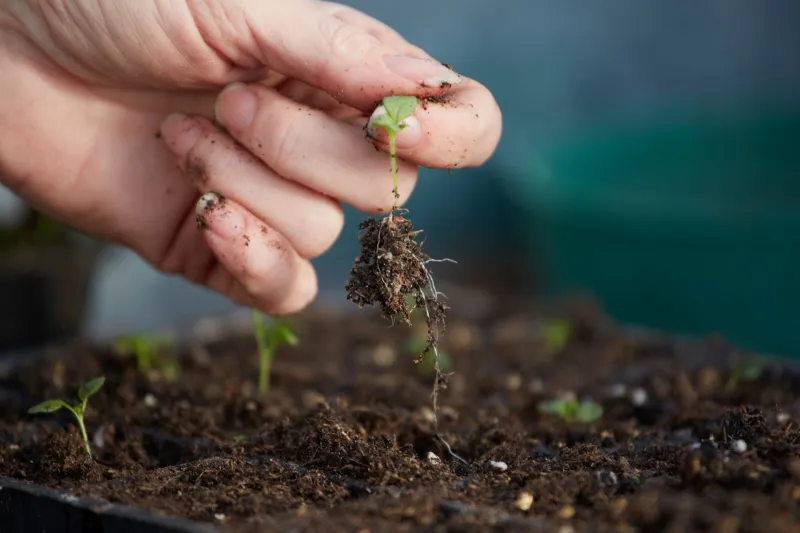
Hemp's deep, branching taproot system — capable of penetrating two to three feet into the soil profile within a single growing season — creates channels through compacted earth that allow water and nutrients to redistribute more efficiently. As those roots decompose following harvest, they contribute organic matter that feeds the microbial communities responsible for mineralizing nitrogen already present in the soil. Peer-reviewed work published in agricultural journals across Europe and, more recently, in U.S. land-grant university studies, consistently points to measurable reductions in synthetic nitrogen requirements for crops planted in rotation behind hemp.
In practical terms, this means a corn or wheat farmer who integrates hemp into a two- or three-year rotation may be able to reduce nitrogen application rates in subsequent seasons without sacrificing yield. In a period when synthetic nitrogen fertilizer prices have swung violently — spiking more than 200 percent between 2020 and 2022 — that potential represents real economic relief for farming operations already operating on thin margins.
The Infrastructure of Influence
So why does this data rarely appear in U.S. Department of Agriculture guidance documents, state extension publications, or the farm bill provisions that govern how billions in agricultural subsidies are directed?
The answer requires following the money with some precision. The synthetic fertilizer industry in the United States is dominated by a small number of enormous corporations — CF Industries, Mosaic, Nutrien — whose combined lobbying expenditures routinely exceed tens of millions of dollars annually. These companies maintain robust relationships with the congressional agriculture committees that write farm legislation, with the land-grant universities that receive significant private research funding, and with the commodity crop organizations that shape the informal consensus around what "good farming" looks like.
None of this constitutes a conspiracy in the legal sense. It constitutes something arguably more durable: an ecosystem of financial incentives that systematically elevates research supporting continued fertilizer use while providing no institutional pathway for research that undermines it. When a soil scientist at a midwestern university proposes a long-term study on hemp rotation effects on nitrogen cycling, that proposal competes for funding against projects backed by fertilizer company grants, commodity board contributions, and USDA programs shaped by decades of conventional agriculture orthodoxy.
The result is not the suppression of science so much as the chronic underfunding of inconvenient science.
What Farmers Are Learning Anyway
Despite the institutional inertia, word travels. Farmers in Kentucky, Colorado, and the upper Midwest who have spent several seasons growing hemp report observations that align closely with what the limited academic literature describes. Soil that feels different — more friable, more responsive — in the years following a hemp crop. Reduced weed pressure, which itself cuts the need for herbicide applications that can disrupt soil microbiology and, in turn, natural nitrogen availability. Input cost lines on spreadsheets that trend modestly downward without a corresponding drop in productivity.
These are anecdotal accounts, and the scientific community rightly demands more rigorous longitudinal data before drawing firm conclusions. But the anecdotes are consistent enough, and geographically distributed enough, that dismissing them entirely requires a certain motivated incuriosity.
What these farmers are doing, largely without institutional support, is running the experiments that federal agricultural policy should be funding at scale.
The Runoff Problem No One Wants to Solve
Beyond input costs, there is an environmental dimension to this conversation that carries its own political weight — or should. Nitrogen runoff from American farmland is among the most significant drivers of freshwater and coastal ecosystem degradation in the country. The hypoxic dead zone in the Gulf of Mexico, fed primarily by nitrogen-laden agricultural discharge from the Mississippi River basin, now covers an area roughly the size of New Jersey in peak summer months.
Regulatory pressure to reduce that runoff is mounting, driven by EPA mandates, state-level nutrient management plans, and growing litigation from downstream communities. Any crop or rotation practice that demonstrably reduces synthetic nitrogen application — and therefore the volume of nitrogen available to leach into waterways — ought to be receiving serious policy attention.
Hemp's potential contribution here is not theoretical. It is documented in the same body of research that the fertilizer lobby has no interest in amplifying. The political will to act on that research, however, requires confronting an industry that has spent decades cultivating relationships precisely to prevent such confrontations.
Rewriting the Policy Conversation
The path forward demands transparency about who is shaping agricultural research priorities and in whose interest. It requires independent, publicly funded, multi-year studies on hemp's effects on soil nitrogen dynamics across diverse American growing regions — the kind of research that land-grant universities were originally chartered to conduct before private funding began bending their institutional priorities.
It also requires that farm bill negotiations include voices beyond the commodity crop and input industry coalitions that have historically dominated the process. Hemp farmers, regenerative agriculture advocates, soil scientists without industry ties, and the rural communities downstream of nitrogen-saturated fields all have standing in this conversation.
The science pointing toward hemp's capacity to reduce synthetic nitrogen dependency is not yet complete. But it is substantial enough to warrant urgent investment — and the fact that it has not received that investment is itself a policy choice. One made, however quietly, in the interests of those who profit from the status quo.
America's farmers deserve the full picture. The soil beneath their fields is already trying to show it to them.