Fields in Flight: How Hemp Rotations Are Quietly Rebuilding Pollinator Populations Across America's Monoculture Heartland
Drive through central Illinois in August and the landscape tells a familiar story. Corn stretches to the horizon in every direction, broken only by the occasional soybean field and the distant glint of a grain elevator. It is a portrait of agricultural efficiency — and ecological silence. The insects that once defined the American countryside, the honeybees, monarch butterflies, native bumblebees, and the countless beneficial species that anchor food webs and pollinate wild plants, have been systematically displaced by a commodity system that prizes uniformity above nearly everything else.
Yet on a growing number of farms across the Midwest, something unexpected is happening. Where hemp has been introduced into crop rotations, researchers and farmers alike are observing what some are beginning to describe as a quiet ecological reawakening — a measurable return of pollinator activity to landscapes that had, for decades, offered these creatures almost nothing.
The Monoculture Problem and What It Costs Pollinators
The scale of pollinator decline in the United States is difficult to overstate. According to data from the U.S. Department of Agriculture, managed honeybee colonies have declined by nearly 60 percent since the 1940s. Wild bee populations have fared even worse, with some native species now functionally absent from agricultural regions where they were once abundant. The monarch butterfly, once a symbol of American ecological vitality, has seen its eastern migratory population collapse by more than 80 percent over the past two decades.
The causes are complex and interrelated — pesticide exposure, habitat fragmentation, climate disruption, and disease all play roles. But agricultural monoculture sits near the center of the problem. Vast fields of corn and soybeans offer pollinators almost no nutritional value. Corn is wind-pollinated and provides pollen of poor quality to bees; soybeans offer modest resources but are typically planted in such density, and treated with such regularity, that they function more as biological deserts than habitat. The result is a landscape that physically occupies the space where diverse flowering ecosystems once thrived, without providing any of the ecological services those ecosystems delivered.
This is the void that hemp, in ways that are still being formally documented, appears capable of filling.
What Hemp Offers That Commodity Crops Do Not
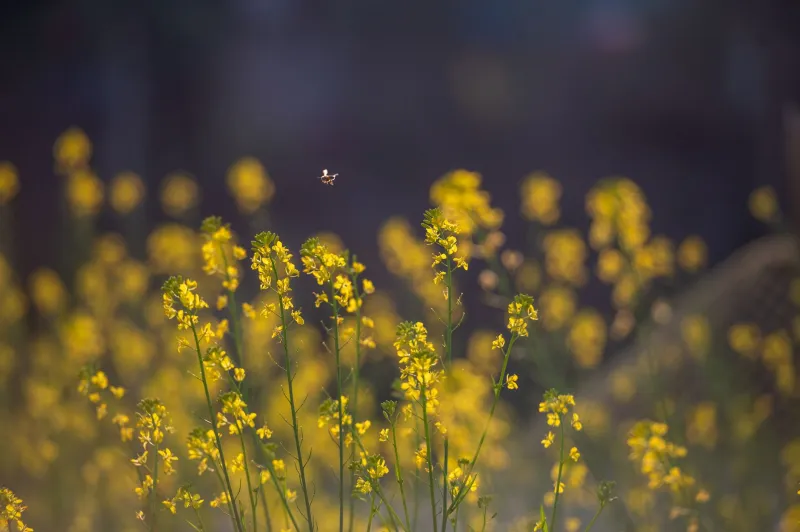
Hemp is, botanically speaking, a generous plant. Its flowers produce pollen in abundance, and while hemp is primarily wind-pollinated, numerous studies have confirmed that bees and other insects visit hemp crops with striking regularity — particularly during the narrow window when pollen is being shed. Research published in Biomass and Bioenergy found that hemp fields attracted more than two dozen bee species, including several native species rarely observed in surrounding agricultural areas. Taller hemp varieties, which produce more floral biomass, were found to attract the greatest diversity of visitors.
Beyond direct floral resources, hemp's structural characteristics make it valuable as habitat. Its dense canopy provides shelter from heat and predators. Its root system stabilizes soil and supports the fungal networks that many ground-nesting bees depend upon. And because hemp is typically cultivated with fewer synthetic inputs than corn or soybeans — particularly in operations pursuing organic or regenerative certification — the fields themselves represent a comparatively low-toxicity environment for insects that have been systematically poisoned elsewhere in the agricultural landscape.
Corridors Across a Fragmented Landscape
The concept of an ecological corridor — a connected strip of habitat that allows wildlife to move between isolated patches — has long been central to conservation biology. In heavily farmed regions like the Midwest, such corridors have largely disappeared, replaced by the hard edges of commodity fields that offer no passage and no refuge.
What makes hemp rotations particularly compelling from an ecological standpoint is their potential to function as temporary but meaningful corridors. A hemp field inserted between two corn fields does not merely benefit the insects that find it; it creates a bridge, however seasonal, that allows populations to move, reestablish, and persist in landscapes that would otherwise trap them in isolated fragments too small to sustain viable communities.
Farmers in Indiana and Ohio who have introduced hemp rotations over the past several growing seasons have reported anecdotal but consistent observations: increased butterfly activity near field margins, higher honeybee presence during hemp's flowering period, and the return of bumblebee species not previously observed on their properties. While rigorous longitudinal studies remain limited — a gap that reflects the broader underfunding of hemp agricultural research — the pattern is consistent enough to have attracted serious scientific attention.
Researchers at Cornell University and Colorado State University have both initiated studies examining the relationship between hemp cultivation and pollinator ecology, with preliminary findings suggesting that the benefits extend beyond the hemp field itself, with elevated insect activity documented in adjacent areas during and after hemp's growing season.
Rotation as Restoration
The practical case for hemp rotations has traditionally been made in agronomic terms: hemp breaks pest cycles, reduces pressure on subsequent crops, improves soil structure, and can reduce the need for synthetic inputs in the seasons that follow. These benefits are real and well-documented. But the emerging pollinator data suggests that the ecological return on investment extends considerably further than the soil profile.
For farmers operating within conservation programs — particularly those enrolled in USDA initiatives that reward habitat creation and biodiversity outcomes — hemp rotations may represent an underutilized tool for meeting program requirements while simultaneously generating a marketable crop. The financial calculus, long a barrier to adoption, becomes meaningfully different when environmental service payments are factored alongside commodity revenue.
Several Midwestern operations have already begun framing their hemp rotations explicitly in these terms, positioning the crop not merely as a fiber or grain source but as a regenerative instrument — one that earns its place in the rotation as much through ecological contribution as economic return.
The Regulatory Gap That Must Be Closed
Despite the growing body of evidence, hemp's potential as a pollinator refuge remains largely absent from federal conservation policy. The USDA's Conservation Reserve Program and Environmental Quality Incentives Program make limited provision for hemp as a conservation crop, reflecting the broader institutional inertia that has slowed hemp's reintegration into American agriculture since the 2018 Farm Bill.
Advocates argue that this is a gap with real ecological consequences. Every growing season in which hemp is excluded from conservation program eligibility is a season in which millions of acres of monoculture farmland remain inhospitable to the insect communities that American agriculture ultimately cannot function without. Pollinators contribute an estimated $15 billion annually to U.S. crop value — a figure that makes their continued decline not merely an environmental concern but an agricultural emergency.
A Living Argument for Diversification
The story of hemp and pollinators is, at its core, a story about what American agriculture loses when it narrows itself to a handful of commodity crops and what it stands to recover when it makes room for biological complexity. Hemp does not solve the pollinator crisis alone. No single crop can. But its demonstrated capacity to attract and sustain diverse insect communities — even within landscapes that have been stripped of ecological function for generations — makes it one of the more promising tools available to farmers who are willing to think beyond the next harvest.
The fields may be quiet now. But the evidence suggests they do not have to stay that way.