From Field to Finished Product: How Vertically Integrated Hemp Farms Are Rewriting the Rules of American Agriculture
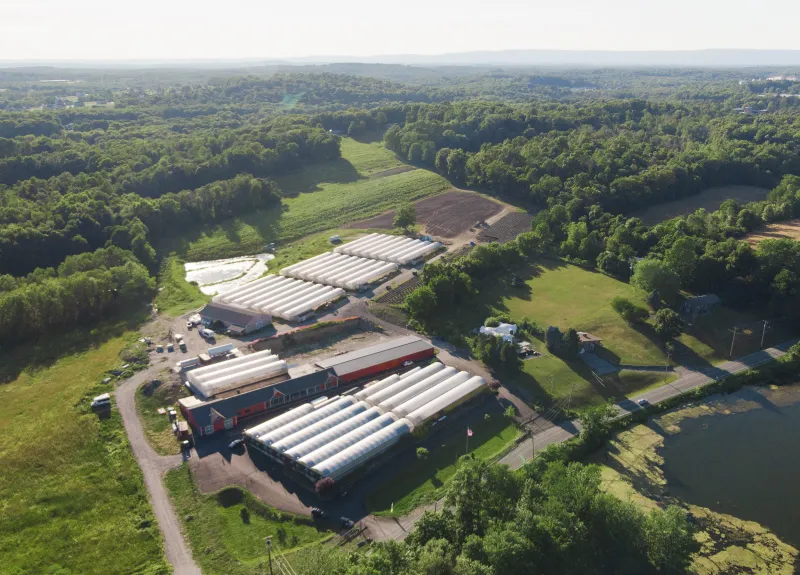
Photo: hemp farm vertical integration processing facility rural America aerial view, via images.squarespace-cdn.com
For most of the twentieth century, American agriculture operated on a principle of radical specialization. Farmers grew crops. Processors processed them. Manufacturers manufactured. Retailers sold. Each node in the chain answered to its own incentives, its own balance sheet, and its own definition of efficiency. The result was a commodity system that moved enormous volumes of product while distributing environmental costs — soil depletion, chemical runoff, carbon emissions from transportation — across a landscape too diffuse to hold accountable.
Hemp, by contrast, is arriving at a moment when that model is under serious scrutiny. And a cohort of forward-thinking hemp operations is demonstrating that the plant's potential extends well beyond its agronomic virtues. These farms are building something structurally different: closed-loop supply chains that compress the distance between cultivation and consumption, and in doing so, are revealing what a more sustainable American agriculture might actually look like in practice.
The Anatomy of a Closed-Loop Hemp Operation
Vertical integration is not a new concept in American business. What makes its application to hemp distinctive is the degree to which the plant's biology encourages — almost demands — it.
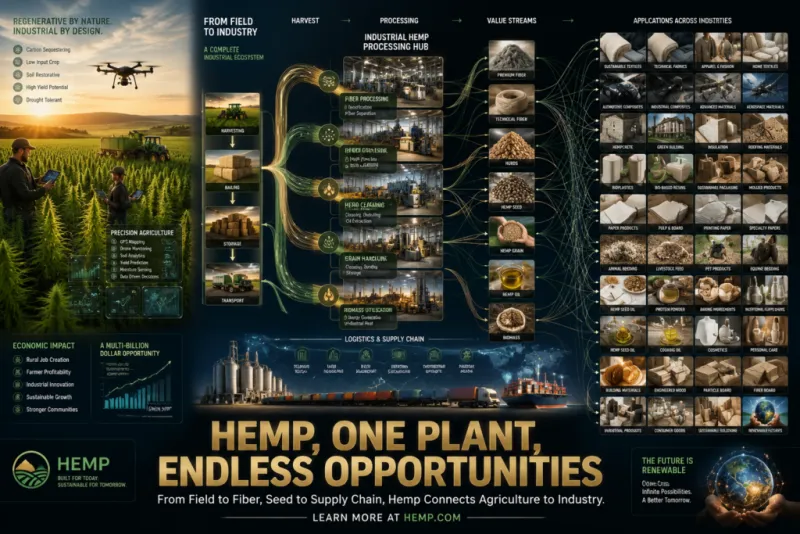
Hemp is extraordinarily versatile. Its seeds yield nutritional oils and protein-rich meal. Its stalks produce bast fiber for textiles and industrial composites, along with a woody inner core called hurd that serves as a building material and animal bedding. Its flowers and leaves contain cannabinoids with documented therapeutic applications. A single acre of hemp can simultaneously supply raw material for a food company, a textile manufacturer, a construction supplier, and a wellness brand.
Farms that recognize this multiplicity and build infrastructure to capture it — on-site decorticators for fiber separation, cold-press extraction equipment for oils, direct relationships with regional retailers and distributors — are not simply adding revenue streams. They are eliminating the inefficiencies and environmental leakage that accumulate at every handoff point in a conventional supply chain.
In Colorado, operations like Panacea Life Sciences have pursued models that bring cultivation, extraction, and product formulation under one organizational roof. In Oregon and Kentucky — states with deep hemp traditions stretching back to the industrial era — smaller family farms have formed cooperative processing hubs that allow individual growers to access shared infrastructure without surrendering autonomy. These arrangements reduce per-unit transportation emissions, cut waste from over-processing, and create tighter feedback loops between what the soil produces and what the market ultimately demands.
The Environmental Logic of Compression
The environmental case for vertical integration in hemp agriculture is not merely theoretical. It rests on a straightforward observation: every mile a raw agricultural product travels before it is processed represents an energy expenditure and an emissions liability. Every intermediate handler who touches a crop introduces packaging, refrigeration, storage, and logistical overhead. And every stage at which a plant's full biological value is not captured represents an opportunity cost — biomass that could have been converted into a useful product instead becomes agricultural waste.
Conventional commodity crops, particularly corn and soy, are processed at massive centralized facilities that may be hundreds of miles from the farms that supply them. Hemp, with its diverse output streams and relatively modest per-acre yield compared to those commodity giants, is poorly suited to that model. The economics of shipping bulky, low-density hemp stalk across interstate distances rarely pencil out. But a farm with its own decorticator can sell finished fiber bales to a regional manufacturer at margins that make the crop genuinely viable — and can do so while keeping processing jobs and economic value within the local community.
This compression also has meaningful implications for soil stewardship. Farms that control their own processing and distribution have stronger incentives to maintain long-term soil health, because they are not selling into an anonymous commodity pool where soil quality is invisible to the buyer. When a vertically integrated hemp farm's brand identity is directly tied to the quality of its finished product, the condition of the land that produced it becomes a competitive asset rather than an externality.
What the Regulatory Landscape Must Catch Up To
Despite the promise of this model, significant structural barriers remain. Chief among them is the patchwork of state-level regulations governing hemp processing, particularly for cannabinoid-containing products. A farm operating across state lines — selling fiber in Ohio, oils in California, and food products in New York — must navigate a labyrinth of differing testing requirements, licensing regimes, and labeling standards that add compliance costs and slow the kind of regional scaling that would make vertically integrated hemp economically accessible to mid-size operations.
The USDA's hemp program, established under the 2018 Farm Bill, provided crucial federal legitimacy to hemp cultivation but left substantial regulatory authority with individual states. The result, as numerous industry observers have noted, is a system that rewards large, well-capitalized operations capable of sustaining compliance teams while placing smaller vertically integrated farms at a structural disadvantage. Meaningful reform would require Congress to establish clearer federal standards for hemp-derived products — particularly foods and supplements — and to fund the rural infrastructure, including processing facilities and testing laboratories, that would allow more farms to participate in closed-loop models without building every component from scratch.
USDA rural development grants and USDA Sustainable Agriculture Research and Education (SARE) program funding have supported some early-stage hemp infrastructure projects, but investment remains modest relative to the scale of transformation that a genuine shift toward vertically integrated hemp agriculture would require.
A Blueprint Worth Building On
What the most successful vertically integrated hemp operations share is a systems-level orientation that is still relatively rare in American agriculture. They are not growing a crop and hoping the market finds it. They are designing supply chains with deliberate attention to where value is created, where waste is generated, and where environmental impact accumulates — and then building structures to address all three simultaneously.
This is, in essence, the regenerative agriculture principle applied not just to soil but to the entire economic architecture of food and fiber production. It asks not only what the land can produce but how that production can be organized to benefit the community, the climate, and the long-term viability of farming itself.
American agriculture has spent decades optimizing for yield and price at the expense of nearly everything else. Hemp's closed-loop pioneers are demonstrating that a different optimization is possible — one that treats the supply chain not as an afterthought but as an instrument of environmental and economic justice.
Scaling that demonstration will require policy ambition, infrastructure investment, and a willingness among legislators and regulators to recognize that the future of American farming may look less like a thousand-acre monoculture feeding a distant processing plant and more like a diversified, regionally rooted operation that knows exactly where its seeds go — and exactly what comes back from them.