Shattered Standards: How America's Patchwork Hemp Testing System Is Ruining Farmers Before They Even Reach Market
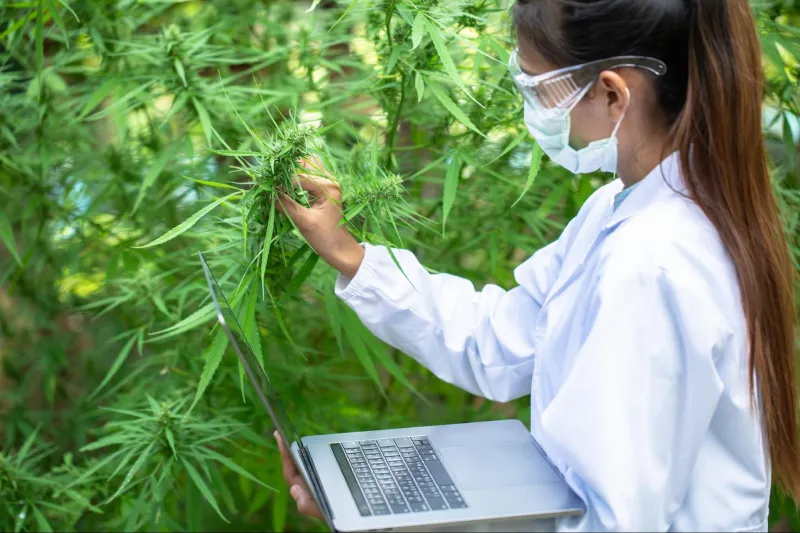
Photo: hemp farmer field crop testing laboratory agriculture, via actlab.com
In the summer of 2022, a third-generation farmer in western Kentucky planted 40 acres of industrial hemp — a crop he had spent two years preparing for, investing in seed genetics, soil amendments, and irrigation infrastructure. When harvest season arrived, he submitted samples to his state-approved laboratory. The results came back: his crop tested at 0.32% total THC, fractionally above the 0.3% federal threshold. The entire harvest was ordered destroyed.
Three weeks later, a neighboring farm with an almost identical crop variety — grown in comparable soil, under comparable conditions — submitted samples to a different certified lab in a neighboring state. That crop passed. It was sold, processed, and entered the supply chain without incident.
The difference was not the plant. The difference was the laboratory.
This scenario is not an anomaly. It is a systemic failure playing out across the United States with increasing frequency, costing hemp farmers hundreds of millions of dollars annually and threatening to strangle the domestic hemp industry before it achieves its enormous potential.
The Measurement Problem Nobody Wants to Acknowledge
At the heart of this crisis is a deceptively technical issue: there is no single, federally mandated laboratory methodology for measuring THC content in hemp. The 2018 Farm Bill established hemp as a legal agricultural commodity distinct from marijuana, defined by a delta-9 THC concentration at or below 0.3% on a dry weight basis. What it did not establish was a uniform scientific protocol for how that concentration should be measured.
The result is a fragmented landscape of state programs, each operating under its own approved methodologies, sampling protocols, and moisture correction procedures. Some states measure total THC — a calculation that includes both delta-9 THC and THCA (the non-intoxicating precursor that converts to THC when heated). Others measure only delta-9. Some laboratories apply a decarboxylation conversion formula; others do not. Sampling windows differ. Sample sizes differ. Even the portions of the plant collected for testing differ significantly from state to state.
A 2021 study published in the Journal of Analytical Toxicology demonstrated that the same hemp sample, tested under different methodological conditions, could yield THC readings that varied by as much as 40%. That variance — invisible to the farmer, opaque to the market — is the difference between a legal crop and a federally noncompliant one.
Small Farmers Are Absorbing the Risk That Policy Has Created
Large agricultural operations with legal teams and established relationships with multiple certified laboratories have developed workarounds. They test early and often, sometimes privately, to gauge where their crop is trending before the official state sampling window opens. They can afford to do this. Small and mid-sized farmers cannot.
For an independent grower operating on tight margins, the official state test is frequently the only test. When that test returns a hot result — industry shorthand for a crop that exceeds the THC threshold — the consequences are immediate and severe. Remediation options are limited. In most states, a failed crop must be destroyed under law enforcement supervision. There is no federal crop insurance backstop specifically calibrated to THC testing failures. There is no appeal mechanism that accounts for laboratory variability.
The American Farm Bureau Federation has documented cases in which farmers lost entire growing seasons to testing failures that independent retesting later suggested were erroneous. Yet by the time alternative results are available, the crop is already gone.
This is not a marginal concern. The USDA's own hemp production data shows that acreage under cultivation dropped sharply between 2019 and 2021, with many smaller producers citing regulatory unpredictability as a primary reason for exiting the industry. The science of hemp cultivation has advanced considerably. The regulatory infrastructure surrounding it has not kept pace.
Where the Federal Standards Stalled
The 2018 Farm Bill directed the USDA to develop a national regulatory framework for hemp production, including testing standards. The agency published an interim final rule in 2019 and a final rule in 2021. While these rules established certain baseline requirements — including the mandate to use DEA-registered laboratories for official testing — they preserved significant latitude for state programs to deviate in their specific methodologies.
Critics argue that the USDA's deference to state discretion was a political compromise that sacrificed scientific coherence. The agency acknowledged in its own rulemaking documentation that the 0.3% threshold itself is not grounded in pharmacological research — it was borrowed from a 1979 Canadian report and has never been validated as a meaningful marker of intoxication risk from hemp.
Meanwhile, efforts to establish harmonized testing protocols through bodies like AOAC International — a nonprofit that develops standardized analytical methods — have proceeded slowly. Draft hemp testing methods have been in development for years. Adoption remains voluntary. And the laboratories certified under state programs are under no obligation to adopt them.
What Standardization Would Actually Require
Scientists and agricultural policy experts who have studied this issue converge on several concrete recommendations.
First, the federal government must mandate a single analytical methodology for official THC testing — specifically, high-performance liquid chromatography (HPLC), which does not apply heat and therefore does not artificially convert THCA to THC during the measurement process. Gas chromatography, which does apply heat, remains in use in some state programs and systematically inflates total THC readings.
Second, the sampling protocol must be standardized. Current state rules vary in which plant parts are sampled, how many samples are drawn per acre, and at what growth stage sampling occurs. These variables introduce enormous noise into what should be a reproducible scientific measurement.
Third, a federal proficiency testing program for hemp laboratories — analogous to programs that exist for clinical and environmental laboratories — should be established and made mandatory for any lab conducting official state testing. Proficiency testing requires laboratories to analyze blind samples of known composition, ensuring that their results fall within acceptable ranges. Without this, laboratory-to-laboratory variability remains unchecked.
Finally, the THC threshold itself deserves rigorous scientific review. Several researchers and farm advocacy organizations have proposed raising the threshold to 1.0% — a level that remains far below any pharmacologically meaningful concentration while dramatically reducing the number of crops that fail due to measurement error or natural genetic variation near the boundary.
The Cost of Continued Inaction
Hemp is one of the most environmentally compelling crops available to American agriculture. It builds soil organic matter, suppresses weeds without herbicides, sequesters carbon, and offers farmers genuine crop rotation value. Its industrial and nutritional applications are expansive and growing. But none of that potential can be realized if the farmers growing it cannot survive the regulatory gauntlet between the field and the market.
The science of hemp is sound. The policy surrounding its measurement is not. Fixing that gap requires federal leadership, methodological rigor, and a genuine commitment to treating hemp farmers with the same regulatory respect afforded to growers of every other legal agricultural commodity in America.
The crop is ready. The question is whether the regulatory system will be.