The Broken Chain: How Disconnected Farmers, Processors, and Retailers Are Costing America's Hemp Industry Its Future
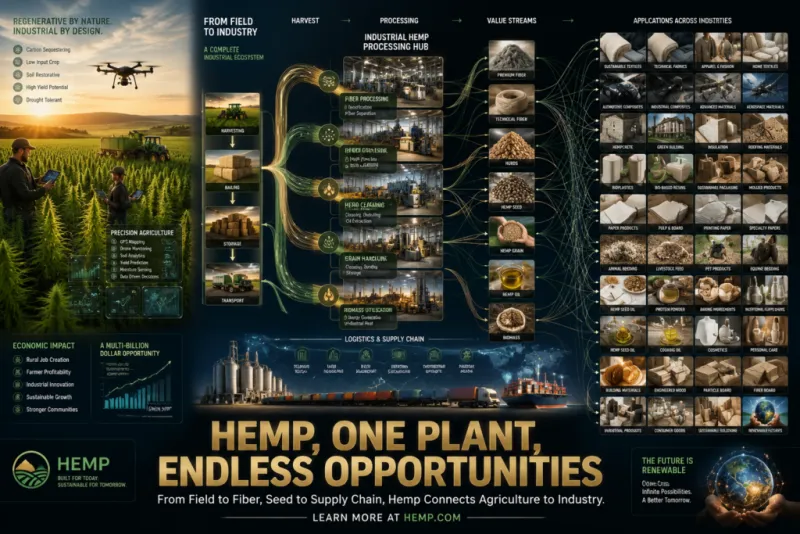
Photo: hemp supply chain logistics farm to factory processing facility aerial, via www.hemp.com
America's hemp industry is producing extraordinary raw material — and then watching much of its value evaporate before it ever reaches a consumer. A fractured supply chain, built without coordination between growers, processors, and retailers, is generating waste, suppressing quality, and inflating costs across every segment of the market. Understanding where the chain breaks — and how to weld it back together — may be the most urgent infrastructure challenge the industry faces.
A Promising Crop Without a Coherent Pipeline
When the 2018 Farm Bill federally legalized hemp cultivation, it effectively reopened a door that had been sealed shut for more than eight decades. Farmers across the country rushed toward a crop with genuine promise: deep roots that rebuild soil structure, a short growing cycle, and an astonishing range of end-use applications spanning textiles, construction materials, nutrition, and medicine.
What the legislation did not create — and what the market has struggled to build independently — was any coherent infrastructure connecting those farmers to the processors who could refine their harvest, or to the retailers and manufacturers who could ultimately place finished goods in front of American consumers. The result is an industry that resembles a highway system where every on-ramp leads to a different road with no shared signs, no unified standards, and no reliable way to merge.
Farmers in Kentucky may grow premium fiber hemp with nowhere local to send it for decortication. Processors in Colorado may operate at a fraction of their capacity because reliable biomass contracts are difficult to secure. Retailers sourcing hemp-derived ingredients frequently cannot verify the origin, testing history, or processing conditions of what they are purchasing. Each gap represents not only economic waste but a structural vulnerability that undermines consumer trust and investor confidence alike.
Where the Chain Actually Breaks
The fragmentation is not concentrated in a single chokepoint — it is distributed across the entire supply network, and that is precisely what makes it so difficult to address.
At the farm level, growers frequently lack market intelligence before they plant. Without firm contracts or transparent pricing signals, many make cultivation decisions based on anecdote and optimism rather than demand data. Oversupply in CBD biomass between 2019 and 2021 left warehouses full of harvested hemp that processors could not absorb at prices that covered production costs. Some estimates placed the volume of stranded biomass in the hundreds of millions of dollars. Farmers bore the financial consequences of a market signal failure that was systemic, not individual.
At the processing level, infrastructure remains geographically sparse and technically inconsistent. Hemp decortication facilities — essential for separating fiber from the woody hurd — are concentrated in a handful of states, forcing farmers in other regions to absorb prohibitive transportation costs or abandon fiber markets entirely. Extraction facilities for cannabinoids vary enormously in their methodologies, equipment quality, and testing protocols, producing outputs with inconsistent potency and purity profiles. When a manufacturer receives batches from three different processors and finds three different quality profiles, the downstream problem becomes a formulation headache and, ultimately, a product reliability issue.
At the retail and manufacturing level, sourcing fragmentation translates into opacity. Brands frequently cannot trace their hemp-derived ingredients to a specific farm, let alone to specific growing conditions or soil management practices. In an era when consumers increasingly demand supply chain transparency — particularly for wellness and food products — this opacity is a competitive liability. It also opens the door to adulteration and mislabeling, which has plagued the CBD market and generated well-documented regulatory scrutiny.
The Cost of Disconnection
The economic toll of this fragmentation is difficult to calculate precisely, but its contours are visible throughout the industry. Redundant testing — conducted separately by farmers, processors, and brands — adds cost without necessarily adding confidence, because testing standards themselves remain inconsistent across state lines. Spoilage of biomass that cannot reach processing facilities in time represents a direct write-off. Small-batch processing runs, necessitated by the absence of consolidated supply agreements, sacrifice the economies of scale that would make hemp-derived ingredients cost-competitive with their synthetic or conventionally grown alternatives.
Perhaps most consequentially, fragmentation suppresses the investment that could accelerate the industry's maturation. Venture capital and agricultural lenders are reluctant to commit capital to a supply chain where counterparty risk is high, quality standards are undefined, and regulatory clarity is incomplete. The infrastructure that would resolve fragmentation — more processing facilities, integrated logistics networks, digital traceability platforms — requires precisely the kind of long-term investment that fragmentation itself discourages. It is a self-reinforcing constraint.
Emerging Solutions: Technology, Contracts, and Cooperation
The good news is that solutions are already being piloted, and some are gaining meaningful traction.
Vertical integration, while capital-intensive, is one proven response. A growing number of hemp enterprises are building operations that span cultivation, processing, and branded product development under a single organizational structure. This eliminates the coordination failures that arise between independent actors and creates a unified quality management system. Companies operating this way can offer retailers the traceability documentation that increasingly defines premium positioning in the market.
Forward contracting and cooperative models offer a path for independent farmers who lack the capital to vertically integrate. When processors commit to purchasing specific volumes at negotiated prices before planting season, farmers can make rational cultivation decisions and processors can plan facility utilization more effectively. Agricultural cooperatives — a model with deep roots in American farming — are beginning to apply this logic to hemp, pooling member production to achieve the scale that individual operations cannot.
Digital traceability platforms are emerging as a connective layer across the supply chain. Blockchain-based and conventional database systems are being deployed to document chain of custody from seed to shelf, capturing testing data, processing records, and logistics information in formats that all supply chain participants can access. When a retailer can scan a QR code on a finished product and trace it to a specific field, a specific harvest date, and a specific set of third-party lab results, consumer trust becomes a verifiable proposition rather than a marketing claim.
What Policy Must Do
Technology and private coordination alone cannot resolve a fragmentation problem that is partly regulatory in origin. Federal and state governments have several concrete levers available.
Unified testing standards — establishing consistent methodologies and acceptable thresholds across state lines — would eliminate one of the most costly sources of redundancy and uncertainty in the current system. The USDA and FDA have the authority and the mandate to develop these standards; what has been lacking is the political will to finalize them.
Investment in processing infrastructure, potentially through USDA rural development programs or targeted grant mechanisms, could address the geographic gaps that strand farmers in states without accessible facilities. Hemp's environmental credentials — its soil-building capacity, its reduced pesticide requirements, its carbon sequestration potential — make a compelling case for treating processing infrastructure as a public good worthy of public investment.
Finally, clearer federal guidance on hemp-derived ingredients in food and dietary supplements would unlock the retail market's full potential. Brands that cannot confidently label and market their products cannot generate the consumer demand that would, in turn, stabilize procurement from processors and farmers. Regulatory clarity is not a peripheral issue — it is foundational to supply chain coherence.
Building the Chain the Crop Deserves
Hemp is not a speculative commodity. It is a scientifically validated, ecologically beneficial, and industrially versatile crop that has earned its place in American agriculture. What it has not yet earned is the supply chain infrastructure commensurate with that potential.
The fragmentation that currently defines the industry from seed to shelf is not inevitable — it is a consequence of rushed legalization without coordinated infrastructure planning, compounded by regulatory ambiguity and insufficient investment. Each of those causes has a remedy. Applying those remedies with urgency is the work that will determine whether hemp's second American era fulfills its promise or collapses under the weight of its own inefficiency.