The Protein Hidden in Plain Sight: How Hempseed Could Quietly Transform What Americans Eat
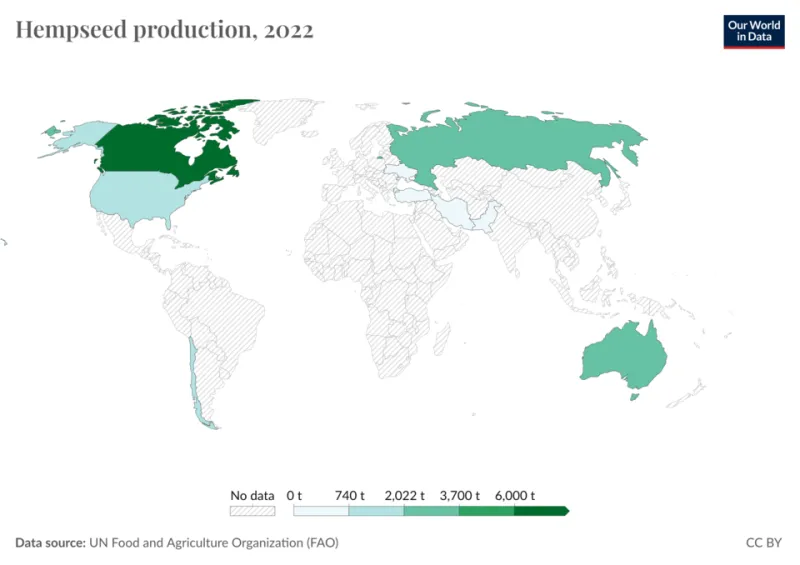
Photo: Our World in Data, CC BY 4.0, via Wikimedia Commons
The American protein market is in the midst of a slow-motion revolution. Sales of plant-based protein products have climbed steadily for a decade. Food technology companies have poured billions into soy isolates, pea concentrates, and mycoprotein fermentation. Grocery shelves that once offered a single brand of tofu now dedicate entire sections to plant-based meat alternatives, protein powders, and fortified beverages.
And yet, sitting largely unnoticed at the edge of this transformation, is a seed that delivers a more complete amino acid profile than either soy or pea protein, grows with minimal chemical inputs, improves the soil it occupies, and has been consumed by human populations for thousands of years.
Hempseed. The overlooked protein that American food culture has barely met.
What the Nutritional Science Actually Shows
The term "complete protein" has become something of a marketing fixture in the wellness industry, but it carries genuine scientific meaning: a protein source that contains all nine essential amino acids — those the human body cannot synthesize on its own and must obtain through diet. Animal proteins are almost universally complete. Among plant proteins, completeness is relatively rare. Soy is one of the few plant foods that qualifies. Hempseed is another.
But the comparison with soy goes further than that basic designation. Hempseed protein is composed primarily of two globular proteins — edestin and albumin — that are structurally similar to proteins found in human blood plasma. This molecular similarity is thought to contribute to hempseed protein's unusually high digestibility. Research published in the Journal of Agricultural and Food Chemistry has reported protein digestibility scores for hempseed that compare favorably with soy and significantly exceed those of pea protein, which remains the dominant ingredient in many commercial plant-based products.
Hempseed also delivers a favorable ratio of omega-3 to omega-6 fatty acids — approximately 1:3, which aligns closely with nutritional guidelines for cardiovascular health. This lipid profile is largely absent from soy and pea protein concentrates, which are typically processed in ways that remove fat content almost entirely.
A single 30-gram serving of hulled hempseed provides roughly 10 grams of protein, 15 grams of healthy fats, and meaningful concentrations of magnesium, iron, zinc, and phosphorus. It is, by any rigorous nutritional accounting, an extraordinary food.
A Supply Chain That Has Yet to Catch Up
So why isn't hempseed protein in every protein bar, plant-based burger, and nutrition shake on the American market?
The answer is not nutritional. It is structural.
The domestic hemp industry — resurrected by the 2018 Farm Bill after nearly a century of federal prohibition — is still in the early stages of building the processing infrastructure that commodity-scale food production requires. Soy protein has the benefit of decades of industrial investment: crushing facilities, fractionation plants, and ingredient supply networks that span the continent. Pea protein, though younger as a commercial ingredient, benefited from substantial venture capital investment in the mid-2010s that accelerated its transition from agricultural curiosity to mainstream ingredient.
Hempseed protein has received no equivalent infrastructure investment. The processing capacity to dehull hemp at scale, fractionate the protein from the fat, and produce a standardized, food-grade isolate with consistent color, flavor, and solubility is still largely underdeveloped in the United States. Most domestic hemp processing is oriented toward CBD extraction. The seed fraction — nutritionally the more compelling product — has been treated as secondary.
Food technology entrepreneurs working in this space describe a chicken-and-egg problem with notable frustration. Ingredient buyers at major food companies want guaranteed volume and consistent specifications before they commit to reformulation. Processors cannot justify the capital expenditure to build that capacity without purchase commitments. And farmers cannot expand hempseed acreage without reliable processing contracts.
The Entrepreneurs Trying to Break the Cycle
Despite these structural barriers, a cohort of food technology companies is actively working to bring hempseed protein into the mainstream American food supply.
Several startups have focused specifically on improving the sensory profile of hempseed protein — historically characterized by a grassy, slightly bitter flavor that limits its use in neutral-tasting applications like dairy alternatives and protein beverages. Novel cold-pressing and enzymatic processing techniques have demonstrated meaningful reductions in off-flavor compounds while preserving protein integrity. One company based in Colorado has developed a water-soluble hempseed protein concentrate with a flavor profile comparable to pea protein isolate, targeting the sports nutrition market as an entry point before pursuing broader food applications.
Others are approaching the challenge from the ingredient formulation side, developing hempseed protein blends that combine its complete amino acid profile with the functional properties — emulsification, gelling, foaming — that food manufacturers require for specific product categories. The logic is pragmatic: rather than asking large food companies to overhaul their formulations, meet them with an ingredient that slots into existing processes.
The retail hemp food market, while still small relative to soy and pea, has shown consistent growth. SPINS retail data has tracked double-digit annual increases in hemp food product sales for several consecutive years, driven primarily by hulled hempseed and hemp-based milk alternatives. The consumer appetite exists. The supply chain is simply not yet equipped to satisfy it at scale.
The Regulatory Ambiguity That Complicates Everything
Overlaying all of these commercial challenges is a regulatory environment that has yet to fully resolve its relationship with hemp-derived food ingredients.
While hulled hempseed, hemp seed oil, and hemp seed protein powder have been affirmed as Generally Recognized as Safe (GRAS) by the FDA, the agency has taken a far more cautious stance on CBD and other cannabinoids in food products. Because hemp and CBD share a common plant origin, some food manufacturers have been reluctant to introduce hemp-derived ingredients into their supply chains out of concern that regulatory treatment could shift.
This conflation of hemp nutrition with hemp pharmacology has been one of the more damaging misconceptions in the industry. Hulled hempseed contains negligible cannabinoid concentrations — the seed itself does not produce CBD or THC; contamination can occur during processing but is manageable with proper handling protocols. The nutritional ingredient and the therapeutic compound are not the same thing, and regulatory clarity on that distinction would meaningfully accelerate commercial development.
The Environmental Case That Transcends Nutrition
Beyond the protein content and the food technology opportunity, hempseed carries an environmental argument that should matter enormously in a food system increasingly under pressure to reduce its ecological footprint.
Soy cultivation in the United States occupies more than 83 million acres, is heavily dependent on synthetic nitrogen fertilizers, and has been a primary driver of habitat conversion globally. Pea protein, while considerably more sustainable than soy, still requires significant water and land inputs to produce at commodity scale.
Hemp, by contrast, is one of the most resource-efficient protein crops available. It requires no herbicides in most growing conditions, fixes atmospheric nitrogen naturally, and can be grown in rotation with other crops to break pest and disease cycles — reducing the chemical burden on adjacent fields. Per unit of protein produced, its land and water footprint is substantially lower than either soy or pea.
For a food system that must feed a growing population while dramatically reducing agricultural emissions, hempseed is not merely an interesting nutritional option. It is a strategic asset.
A Market Waiting to Be Claimed
The plant-based protein market in the United States is projected to exceed $15 billion in annual sales within the decade. The ingredient landscape that will define that market is still being written. The companies, crops, and processing technologies that secure dominant positions now will shape what Americans eat for a generation.
Hempseed protein has every scientific qualification to claim a significant share of that future. What it lacks — still — is the policy clarity, infrastructure investment, and mainstream visibility to convert nutritional promise into market reality.
That gap is not inevitable. It is a choice. And it is one that American agriculture, food technology, and regulatory policy have every reason to make differently.