Stocked Everywhere But Here: The Quiet Suppression of Hemp Seed in American Grocery Aisles

Photo by Photo by clement proust on Unsplash on Unsplash
Walk into a Costco in Toronto or a Carrefour in Lyon, and you will find hulled hemp seeds — sometimes called hemp hearts — shelved alongside chia, flax, and sunflower products, treated as entirely unremarkable pantry staples. Walk into a Kroger, a Publix, or a Walmart in most American cities, and the story changes dramatically. If hemp seed appears at all, it is tucked into a specialty health foods section, priced at a premium, and stocked in quantities that suggest the retailer is unconvinced anyone will actually buy it.
That contrast is not accidental. It is the product of decades of regulatory confusion, supply chain dysfunction, and a retail culture that has struggled to separate hemp from its more controversial botanical relatives. The result is a market paradox: a crop with a nutritional profile that rivals — and in several respects surpasses — conventional protein sources sits largely invisible to the American consumer, while the rest of the industrialized world treats it as a grocery staple.
A Nutritional Profile That Should Sell Itself
The science here is not ambiguous. Hemp seeds contain all nine essential amino acids, making them one of a small number of plant-based complete proteins. Their ratio of omega-6 to omega-3 fatty acids — approximately 3:1 — falls within the range nutrition researchers consider optimal for cardiovascular health, a balance that most Western diets fail to achieve. A three-tablespoon serving delivers roughly ten grams of protein, along with meaningful quantities of magnesium, zinc, iron, and phosphorus.
Compared to the soy-based products that dominate American plant protein markets, hemp seed requires no processing with hexane solvents, produces no significant estrogenic compounds, and is rarely associated with the digestive sensitivity that affects a portion of soy consumers. Compared to flaxseed, it requires no grinding to unlock bioavailability. The nutritional case for broader distribution is, by any objective measure, compelling.
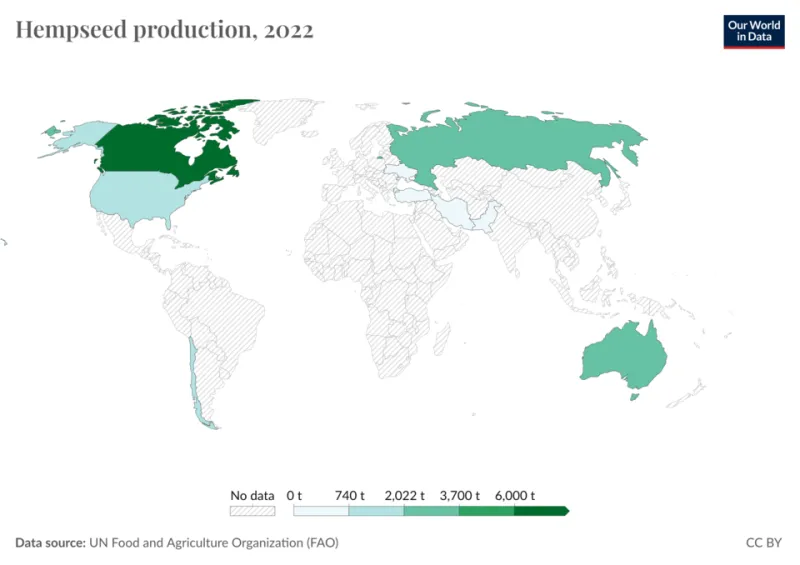
Yet per capita consumption of hemp seed in the United States remains a fraction of what Canadian consumers purchase annually, despite the two countries sharing a border, a language, and largely overlapping food cultures.
The Regulatory Shadow That Never Quite Lifted
For most of the twentieth century, the legal status of industrial hemp in the United States was functionally equivalent to that of its psychoactive cousin — prohibited, stigmatized, and administratively buried. The 2018 Farm Bill represented a watershed moment, removing hemp from the Controlled Substances Act and opening the door to domestic cultivation. What it did not do was immediately clarify the regulatory pathway for hemp-derived food products at the federal level.
The Food and Drug Administration has maintained a posture of studied ambiguity toward hemp seed ingredients in food, distinct from CBD but still subject to the broader uncertainty that clouds the entire hemp-derived product category. For large grocery chains with national footprints and legal teams conditioned to avoid regulatory exposure, that ambiguity has functioned as a de facto barrier. Buyers at major retail chains have told industry representatives, on background, that they will not aggressively merchandise a product category that might invite federal scrutiny — regardless of what the underlying science supports.
This is a structural problem, not a consumer demand problem. Studies consistently show that when American shoppers are educated about hemp seed's nutritional properties, purchase intent rises sharply. The bottleneck is not at the consumer end of the supply chain.
The Supply Chain Gap Between Farm and Shelf
Domestic hemp seed production has grown substantially since 2018, but the processing infrastructure necessary to move raw seed into retail-ready packaged product remains underdeveloped. Dehulling facilities — which produce the consumer-friendly hemp hearts that dominate retail formats — are concentrated in a small number of states and operate at capacities that cannot yet reliably supply national distribution networks.
This creates a second-order problem: when a regional grocery chain does decide to stock hemp seed, sourcing consistency becomes a challenge. Buyers accustomed to the logistical predictability of established commodity supply chains find hemp seed procurement more complicated than it should be. Some retailers have stocked the product, encountered supply interruptions, and quietly deprioritized reorders — not because consumer interest was absent, but because the back-end infrastructure failed them.
Canada, by contrast, built its hemp processing sector across the 1990s and 2000s, when domestic cultivation was already legal and market demand was developing steadily. Companies like Manitoba Harvest scaled into vertically integrated operations capable of supplying international retail accounts with consistent volume and quality. The United States is now attempting to compress decades of supply chain development into a much shorter window, and the gaps are visible at the retail level.
What European and Canadian Retailers Understand That American Chains Do Not
In markets where hemp seed has achieved mainstream distribution, the merchandising logic is straightforward: the product is positioned not as a specialty health item but as a functional food ingredient — something a home cook adds to a smoothie, a salad, or a grain bowl for nutritional density rather than ideological reasons. The branding emphasizes versatility and taste rather than leading with the plant's complicated American history.
American retailers have been slower to adopt this framing, in part because the initial wave of hemp consumer products in the United States arrived alongside CBD-infused everything, creating an association between hemp ingredients and wellness marketing that carries a certain cultural freight. Hemp seed is not a supplement. It is food. The distinction matters enormously for how mainstream grocery buyers think about shelf placement, pricing strategy, and consumer education.
Industry advocates argue that the path to broader distribution runs through exactly this reframing — decoupling hemp seed from the broader hemp wellness narrative and positioning it squarely within the competitive protein and healthy fats categories where its nutritional credentials are strongest.
The Policy Changes That Could Accelerate the Shift
Several concrete interventions could meaningfully accelerate hemp seed's path into mainstream American grocery distribution. Explicit FDA guidance clarifying the status of hemp seed as a conventional food ingredient — separate from CBD and other hemp-derived compounds — would remove the regulatory ambiguity that has made large retailers cautious. Investment in domestic processing infrastructure, whether through USDA programs or state-level agricultural development initiatives, would address the supply consistency problems that have frustrated early retail adopters.
Equally important is a coordinated industry effort to standardize product labeling, quality benchmarks, and consumer-facing messaging. The fragmentation that currently characterizes hemp seed retail — inconsistent terminology, varying quality tiers, no shared certification framework — makes it difficult for buyers to evaluate products confidently and for consumers to develop the brand loyalty that sustains shelf space over time.
The Cost of Continued Delay
Every year that hemp seed remains a specialty-aisle product rather than a mainstream grocery staple represents a missed opportunity at multiple scales. For American farmers, it means a high-value crop that cannot reach its commercial potential. For consumers, it means continued reliance on protein sources with larger environmental footprints and, in many cases, inferior nutritional profiles. For the broader project of building a more sustainable American food system, it means squandering one of the most promising ingredients available.
The barriers are real, but none of them are immovable. Regulatory clarity, infrastructure investment, and a disciplined shift in how the industry presents hemp seed to mainstream retail buyers could, within a few years, put hemp hearts next to chia seeds in every grocery store in the country — where they have always belonged.