Cutting Through the Green Haze: A Rigorous Look at Hemp's Real Carbon Footprint
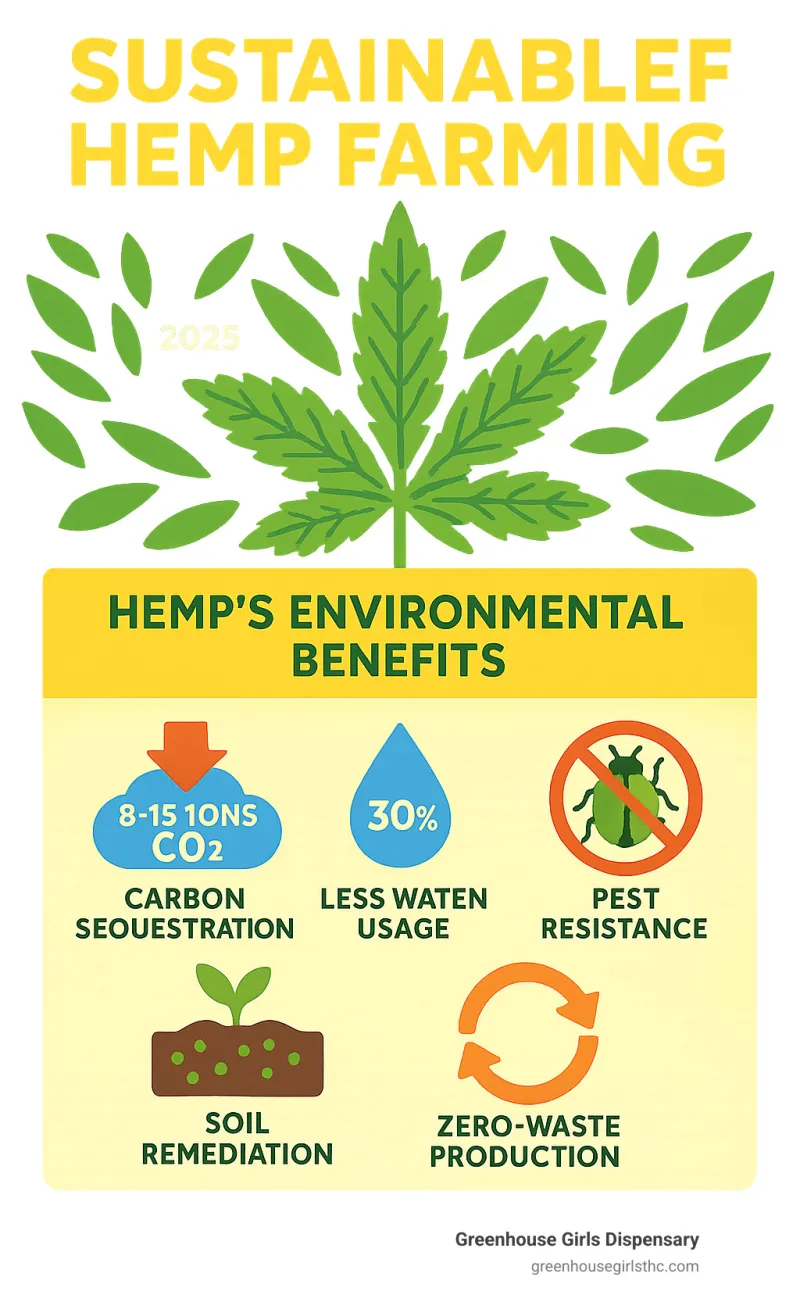
Photo: hemp products carbon footprint sustainability environmental science lab, via images.bannerbear.com
Walk the aisles of any natural goods retailer, scroll through the product pages of any hemp brand worth its seed-to-shelf branding, and you will encounter a familiar constellation of claims. "Carbon negative." "Climate-healing." "The most sustainable crop on Earth." The language is confident, the font is tasteful, and the implied message is clear: buying this product is an act of environmental virtue.
Some of those claims are defensible. Others are not. And the inability — or unwillingness — of many hemp companies to distinguish between the two is doing real damage to an industry whose legitimate environmental credentials are, in fact, quite strong.
This is an opinion, and it is stated plainly: greenwashing in the hemp sector is a problem that the hemp advocacy community should be far more aggressive in confronting. Not because hemp is unworthy of its green reputation, but because that reputation will only remain durable if it is grounded in honest science.
What the Carbon Sequestration Data Actually Shows
Let us start with the numbers, because they are genuinely impressive — within their proper context.
Peer-reviewed research, including a lifecycle assessment published in the Journal of Cleaner Production, has found that hemp cultivation can sequester between 8 and 15 tonnes of CO₂ equivalent per hectare over a single growing season. That figure places hemp among the most carbon-absorptive annual crops in commercial production, outperforming corn, soybeans, and wheat by a substantial margin. A 2020 study from the Nova Institute in Germany, examining industrial hemp for fiber production, estimated net carbon sequestration of approximately 0.67 tonnes of CO₂ per tonne of dry hemp fiber produced — a figure that accounts for agricultural inputs but does not include processing or transportation.
These are real numbers, derived from real data. They are worth communicating. They are not, however, the end of the story.
Sequestration during cultivation is only one phase of a product's carbon lifecycle. What happens to that sequestered carbon after harvest depends entirely on what the plant material becomes. And this is where many hemp companies' environmental narratives quietly collapse.
The Processing and Transportation Problem
A hemp plant growing in a Kentucky field is, in a meaningful sense, a carbon sink. That same plant, once harvested, retted, decorticated, spun, woven, dyed, cut, sewn, packaged in plastic, and shipped from a manufacturing facility in Southeast Asia to a distribution center in Ohio before arriving at a consumer's door — is a considerably more complicated carbon story.
Lifecycle assessments (LCAs) that account for the full value chain consistently show that processing and logistics can erode a significant portion of hemp's cultivation-phase carbon advantage. The degree of erosion depends on several variables: the energy source powering processing facilities, the distance between growing region and manufacturing site, the transportation mode used at each stage, and the end-of-life fate of the product itself.
A hemp T-shirt made from domestically grown fiber, processed in a facility powered by renewable energy, and manufactured in the United States, has a genuinely favorable carbon profile. That same T-shirt, made from fiber shipped to China for processing and returned as finished goods via container ship, has a substantially worse one — though it may still outperform conventionally grown cotton, which carries its own heavy environmental burden.
The problem is that most hemp product companies do not commission rigorous LCAs. They cite the cultivation-phase sequestration data — the most favorable number available — and allow consumers to assume that this figure represents the product's total environmental impact. It does not.
A Framework for Evaluating Hemp Environmental Claims
Consumers who want to make genuinely informed purchasing decisions need a set of questions that go beyond the marketing copy. The following framework is not exhaustive, but it addresses the most common sources of misleading environmental claims in the hemp sector.
1. Does the carbon claim cover the full lifecycle? A claim that references only agricultural sequestration is incomplete. Ask whether the company has conducted or commissioned a full LCA that includes processing, manufacturing, transportation, and end-of-life disposal.
2. Where was the hemp grown, and where was it processed? Domestic cultivation paired with domestic or near-shore processing represents a meaningfully different carbon profile than globally dispersed supply chains. Companies that can answer this question with specificity are more credible than those offering vague "sustainably sourced" language.
3. What energy source powers the processing facilities? This single variable can dramatically shift the carbon math. Fossil-fuel-powered decorticating and fiber processing facilities can negate a substantial portion of the crop's sequestration benefit.
4. What happens to the product at end of life? Natural hemp fiber is biodegradable — but only under the right conditions. Hemp blended with synthetic fibers, or treated with chemical finishes, may not degrade cleanly. Hemp-based building materials like hempcrete lock carbon in for the life of a structure, which is a genuinely strong climate argument. Hemp paper, if it replaces wood pulp paper, offers real forest preservation benefits. These distinctions matter.
5. Is the company's carbon offset claim verified? Some companies purchase carbon offsets to claim neutrality. The quality of offset programs varies enormously. Third-party verification from recognized bodies such as Gold Standard or Verra is a meaningful signal; self-reported offset claims are not.
Where Hemp's Climate Case Is Genuinely Unassailable
Criticism of greenwashing should never be mistaken for skepticism about hemp's environmental value. There are specific, well-documented applications where hemp's climate benefits are robust enough to withstand the most rigorous scrutiny.
Hempcrete — a composite of hemp hurd, lime binder, and water used in construction — is one of the most compelling examples. Buildings constructed with hempcrete walls continue to sequester carbon throughout their operational life, as the lime binder undergoes a slow carbonation process that permanently mineralizes atmospheric CO₂. Research from the BRE (Building Research Establishment) and independent academic sources estimates that hempcrete walls can sequester between 35 and 165 kg of CO₂ per square meter, depending on thickness and formulation. In a construction sector that accounts for roughly 40 percent of global carbon emissions, this is not a trivial contribution.
Hemp fiber as a replacement for fiberglass in composite materials is another area where the carbon arithmetic is favorable. Fiberglass production is energy-intensive and the material is not biodegradable. Natural hemp fiber composites, increasingly used in automotive panels and consumer goods, offer comparable mechanical properties with a significantly reduced carbon footprint across the full lifecycle — a finding supported by LCA research published in Resources, Conservation and Recycling.
Hemp grain and seed oils, when produced domestically and consumed regionally, represent a protein and fat source with a lower land and carbon footprint than many conventional alternatives. These are honest, defensible claims.
The Integrity Argument
The hemp industry is young, politically contested, and operating in a regulatory environment that remains inconsistent across state lines. In that context, the temptation to reach for the most favorable environmental framing is understandable. The consequences of succumbing to that temptation, however, are serious.
Federal regulators, academic critics, and competing industries are watching the hemp sector's environmental claims with increasing attention. Overreach — claims that cannot survive scrutiny — provides ammunition to those who would prefer to see hemp remain marginalized. It also erodes consumer trust in ways that are difficult to rebuild once lost.
The science supporting hemp's genuine environmental contributions is strong. It does not need embellishment. What it needs is honest communication: specific claims, properly scoped, supported by verifiable data, and honest about what remains uncertain.
That standard of integrity is what will distinguish the hemp industry's environmental advocacy from the greenwashing it should be working to transcend. Hemp deserves better than marketing copy. So do the consumers, farmers, and advocates who have staked something real on its promise.